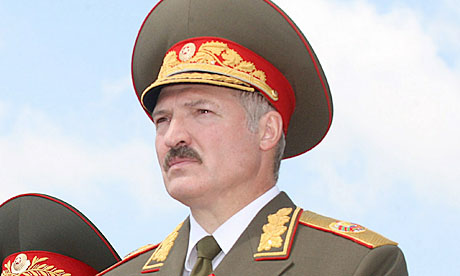
In response to continued sanctions from the European Union, Belarus has ordered the Polish and EU ambassadors to leave the country. The sanctions began after the last election in December 2010, that is considered by many to have been fixed. Many who protested the final vote are still imprisoned. The latest sanctions were in response to Belarus's poor record on human rights.
Germany has led a call for all EU nations to respond by pulling their ambassadors out of Belarus. "This is the last dictatorship, this is the last dictator in Europe,
and we will not let ourselves be intimidated by such actions against one
European institutions or against one member state," German Foreign
Affairs Minister Guido Westerwelle said.
"The European Union and Poland can rely on Germany's solidarity. We
will not let others divide us. The dictator fools
himself when he thinks he can divide us. We will react together. I
suggest that we all recall our ambassadors from Belarus to our capitals.
This is what Germany will do."
The United States also has sanctions against the Belarus's leadership. In December 2011, a year after the questioned elections, the US expanded their own sanctions, but with little complaint from Belarus. It is unknown if the US will join the EU in pulling their ambassador, but it is very possible as the two groups have been working closer and closer together on many subjects, including Iran and Syria.
President Alexander Lukashenko has had run ins with the US and EU before. Nor is this the only election under him to be challenged. During the 2010 elections, other candidates were attacked, kidnapped, and or arrested by police. Since first being elected in 1994, he has officially gained all but total control, and wields authoritarian powers without challenge from the rest of the government.
This fun epic adventure, set in colonial India and based on Rudyard Kipling’s writing, is the ultimate buddy movie. John Huston originally planned it for Humphrey Bogart and Clark Gable, then Gable and Michael Caine, and finally ended up with Caine and Sean Connery, a fantastic combination.
They play Peachy and Danny, British soldiers with reputations as fraudsters, who embark on an audacious scheme, going to a fabled ancient kingdom in Afghanistan where they plan to bamboozle the natives, rule as kings and revel in untold riches and power.
If the film has a lesson, it may be that colonial ambition is folly and failure, or that it’s futile to impose strict order and discipline on a tribal people, certainly that it’s always wrong to believe your own hype. No matter what moral (if any) you take away, you can’t help but admire the arrogant but charming and amusingly clever con men who tragically overestimate how easily their plan will unfold. They gain trust by acting as military “consultants” and help the people of Kafiristan defeat an enemy. Due to the tribe’s limited understanding of modern weaponry and the protection of armor, they are awestruck when an unscathed Connery seems immortal; he seals the deal and seems God-like when his medallion suggests he is the reincarnation of Alexander the Great.
While Connery lets the worship go to his head and becomes the image of hubris, Caine stays true to his cynical self, and is totally focused on the original goal of making off with gold. Predictably, Connery takes things too far and ignores warnings against getting involved with a woman; Michael Caine’s real wife Shakira plays the beautiful object of Connery’s affection and the occasion of his exposure as a mere mortal.
The Man Who Would be King was nominated for four Oscars, but none for acting, which is a shame because the key to the movie, besides the amazing scenery, exciting nonstop pace, appropriately spare Maurice Jarre score, funny lines, and recent Oscar winner Christopher Plummer as narrator/Kipling, the best thing apart from all that is the completely believable bond of friendship grounded in the special chemistry between Caine and Connery. It’s a fun, entertaining throwback to early Hollywood adventure films, neither shallow nor preachy, and like another John Huston classic, The Treasure of the Sierra Madre, shows how a lust for gold and the grandest of plans fall apart because of human stupidity.
This is cross posted from Speakeasy, where you can find further classic entertainment geekery.
More so than in past years, I've noticed more questions from my fellow Protestants about why we would or even should observe Lent. That of course ties in to a larger question of how and why we observe a liturgical calendar at all. And yes, even the people who just shuddered at the term "liturgical calendar" most likely follow one: Christmas, Easter, and Thanksgiving (unless you aren't thanking anyone in particular) are all feasts in your liturgical calendar.
First, a tiny primer of Lent. Lent is the 40 day season of fasting (minus Sundays) recalling Christ's sacrifice for us and preparing our hearts for Easter. Ash Wednesday, the beginning of Lent was February 22 and Easter is April 8. Why aren't Sundays included in Lent? Because every Sunday is a "Resurrection Sunday" and we always feast and celebrate our risen Lord, so Sunday is never a fast day.
But why don't more Protestants observe Lent? Part of it comes from a distrust of "meaningless traditions" and the desire not to add anything to what God requires. I agree that we should always be making sure our form doesn't get in the way of our substance.
Unfortunately in pursuing the very good goal of Christ Alone, we've thrown out many good and beneficial tools that point us to Christ and strengthen our faith.
Traditions are some of these tools that help us remember God's goodness to us and to reinforce His truth. Sort of like an on going catechization. (Is too a word. Or is now a word.) Nobody has no traditions. Which is not technically a sentence with a double negative, but still convoluted. So rather: Everyone has at least some traditions. Do you celebrate birthdays? Anniversaries? Mother's Day? Arbor Day? Traditions. What about treasured possessions: wedding rings, baby books, and "my first" anything? Traditions. One of our family traditions is having chocolate chip pancakes on Saturdays. Even something as simple as breakfast can become a tradition that helps draw our family together.
Throughout the Bible, anytime God did something for his people, they'd build an altar so that they would remember. Why did he do this? I mean He parted the Red Sea and held back the waters of the Jordan? Who would forget that?
Well, we would! This is what we are:
If the Israelites needed reminders, how much more do we need them in our over stimulated, multi-tasking culture? Celebrating birthdays isn't about cake. Well, it's not all about cake, it's telling someone we care about that they're important. Traditions are a way we remember and elevate the important things of life.
C.S. Lewis wrote, "Humans are amphibians - half spirit and half animal. As spirits they belong to the eternal world, but as animals they inhabit time." This explains why attempts to merely "think" or "feel" ourselves into some preferred spiritual state are destined to fail. We need actions and behaviors to pull our bodies along our spiritual walk. And we also need the rhythms of seasonal change.
Just as we can't always be fasting, we can't always be feasting. Many of us feel relief when the Christmas tree comes down, the decorations are put away, and we get back to "normal life." And I love Christmas, from the first Sunday of Advent through the Feast of Epiphany. The year is marked with seasons, so that every year we get not just a new spring, but a renewed spring. Annual traditions remind us what God has done and what he will continually do for us. His mercies are both new and renewed.
"Of course! That's why we celebrate Easter," you counter. "Why do we need Lent and all that icky fasting?" Particularly in this culture we seem more than willing to celebrate any feast we can: Thanksgiving, Christmas, Easter, Groundhog Day--a.k.a. the celebration of sausage. Give us an excuse to party and we are so there. That's why many of us had pancakes or King Cake or copious amounts of alcohol on Mardi Gras, but have no intention (or even knowledge of) observing Lent.
The Lord ordains fasts as well as feasts, and fasting and feasting are two sides of the same coin. The fast makes the feast sweeter, the feast makes the fast more meaningful. It's something we miss in our fast paced, get it now, do it now, instant gratification culture: the joy of anticipation and the pleasure of a feast well earned. In some ways, the cycle of feasting and fasting points to the greater truth that our life on earth is something of a fast in preparation for the eternal Feast with our King.
The Lenten Season is most notably known as a fasting season. The idea of any fast is to put away worldly things and making our flesh conform to the things of the spirit. Traditionally, that means abstaining from some or all food. Nothing brings into sharp relief the strength of our flesh quite like denying it food. But you can abstain from all sorts of things in order that you draw close to God. Some people seem to give up sweets or social media or whatever as a sort Spartan act of denial or some sort of self-improvement exercise. However, the biblical purpose of a fast is to draw near to God, which is why you'll often find the phrase "prayer and fasting" throughout the Bible and other Christian literature.
And now for true confessions from April. I'm not currently fasting anything this Lenten season, at least not yet. I did give up almost all sugar, but that's not for a season and it was for health reasons. So that's not a fast, just my own version of self-torture. (Girl Scout Cookies just came in. Samoas!!! Frozen Thin Mints!!!!) My pastor in Virginia had this wonderful schedule where we'd fast something for a week and dedicated ourselves to a virtue (which he called fasting from and fasting to) for the 6 weeks of Lent. For example, we'd fast from social media and fast to hospitality. I may do that. Or not. Who knows!
Even though I'm not fasting, our family is observing Lent through a Lenten Tree. You can even celebrate a Lenten season that isn't the full 40 days of Lent. Noel Piper has a wonderful book called Treasuring God In Our Traditions that has many great ideas for all sorts of traditions, including Easter and Lent. Bonus: it's a free download from Desiring God! Yeah, buddy!
These are only a couple of ideas for marking Lent. A quick google search of Lenten Devotions brings up enough resources to fulfill your wildest devotional desire. I hope you find some way of marking the season that draws you closer to Jesus. Even though Lent has "officially" started, there is still plenty of time to mark the season. Even if you only concentrate on Holy Week, I think you'll find it makes Easter Sunday more joyous.
My point of this longer than I intended it to be post is that the Lenten Season is a very wonderful and useful tradition. Beyond just advocating for observing Lent (which I do), I encourage you to look into your traditions. Good traditions of both the fast and feast persuasion are useful tools in our sanctification. And of course there are those traditions that are neither good nor useful. But that's another post.
Cross-posted from my blog OddlySaid, where things are said oddly.
No matter which study you read, one thing remains the same, there is a lot of oil available in the territory of the United States, both on and off shore. The United States Geological Service shows that there were 45 billion barrels of oil to be gained in 2005. The Investor Business Daily says there are 112 billion barrels of oil just lying there right now. And the Institute for Energy Research, suggests that there are trillions to be found. Taking the IBD's 112 billion, would give enough gas for 60 million cars, for 60 years.
At the North American Prospect Expo, the Obama administration was heavily criticized for it's hampering of the American economy, by not allowing the country to use it's own oil. Bruce Vincent, president
of Houston oil and natural gas producer Swift Energy, stated that "These have been the most difficult three years from a policy
standpoint that I've ever seen in my career. They've done nothing but restrict access and delay permitting. The Obama administration, unfortunately, has threatened this
industry at every turn."
White House press secretary Jay Carney said President Obama had "put in place policies that will dramatically
expand the amount of exploration in the Gulf of Mexico, will expand the
amount of exploration in Alaska, will expand the amount of natural gas
production here in the US". Yet the administration has revoked 77 oil and gas licenses, in Utah, Wyoming, and Colorado, in 2012 alone. That area has the world's largest deposits of shale oil, and according to the Rand Corp, holds between 1.5 and 1.8 trillion barrels of crude.
Under President Obama, gas prices in the United States have gone from an average of $1.89 a gallon, to their current average of $3.47. And Obama threatens the country with promises of it going up to five dollars a gallon. Presidential candidate, former Speaker of the House, Newt Gingrich, has put forth his plan to get the prices back down to at least $2.50 a gallon. Most of his plan includes drilling here, drilling now, and working with friendlier countries such as Canada, who won't threaten to cut oil off from us as some middle eastern countries like to do.
Environmentalists use scare tactics about how entire habitats will be destroyed by drilling for oil. One of their favourite places is the Arctic National Wildlife Reserve, where an estimated ten billion barrels worth is available. If you listen to them, they would have you believe that the entire park would be marred and killed by using the oil that is there. In reality though, only 2,000 acres out of 19 million would be touched.
The benefits of using our own oil is beyond the obvious of it's being cheaper. The jobs it would create would boost the economy in many ways as well. Ending our reliance on foreign sources, would make the US stronger and back to being more dependent.
Haitian Prime Minister Garry Conille surprised the world and shocked Haiti, when he resigned Friday. After serving only four months, he left office in protest of government officials, including President Michel Martelly, holding dual citizenship. Dual citizenship is not recognized by Haiti. Many Haitians worry that officials might be being controlled by the country they hold their other citizenship in.
United Nations Secretary-General Ban Ki-moon expressed his concern
following Conille's resignation. "This resignation comes at a time when
the Haitian people are eager to embark decisively on the path towards
reconstruction, economic growth and the strengthening of the country's
rule of law institutions," Ban's spokesman said. "The Secretary-General
urges the Haitian authorities to act in the interests of the Haitian
people and appoint a new prime minister as soon as possible.
The singer songwriter was easily one of the most influential artists in the 20th century. Known mostly for his country music, he also played rock and roll, blues, gospel, and folk. One of the most famous parts of his life was the romance he shared with June Carter.
Born in Arkansas, February 26, 1932, he served in the United States Air Force 1950-1954, in Germany, as a Morse Code Interceptor Operator, working on snatching Soviet transmissions from the air waves. He was the first operator to pick up the news of Josef Stalin's death.
It was in Germany that he formed his first band. His second band would be the one that would get him noticed. On December 4, 1956, whilst Cash and the Tennessee Two were cutting tracks, Elvis Presley and Jerry Lee Lewis dropped by and an impromptu jam session occurred, that would end up leading to a multi state tour for the lot. Cash's career would last until the day he died, September 12, 2003.
Unfortunately, throughout his career he battled with addictions to alcohol, prescription drugs and, at times, illegal drugs as well. Because of this he served jail times, which only added to the outlaw image his songs had given him.
Johnny Cash, would most want to be remembered for three things. His music, his love for June and his family, and for serving God. No matter his struggles, he always found his way back to his Saviour.
Ryan Braun, outfielder for the Milwaukee Brewers, has won his appeal against a Major League Baseball 50 game suspension after he tested positive for performance enhancing drugs. Since being charged with it he has consistently maintained his innocence. Friends, such as Green Bay Packers quarterback Aaron Rodgers, were also quick to defend him, and state the accusations as ludicrous.
The decision to over rule the suspension was based on two key things. First, the urine sample had been stored at one of the testers homes, rather than sent directly to the lab, leaving an obvious tampering window. And secondly, the ratio of testosterone to epitestosterone was five times normal, an impossibly elevated level.
The 28 year old won the National League's Most Valuable Player award last year, and since winning Rookie of the Year in 2007 has been an All Star every year. He currently has a five year contract worth $105 million.
February 25, 1862. The United States government, faced with running out of gold and silver, with which to pay for the civil war, passes the Legal Tender Act. The Act allows the federal government to print paper money, that is not backed by an equal amount of specie.
Bankers, economists, and some congressmen predicted that doing so would destroy the economy. But the greenbacks, as they were called, did not end the world as it was then known, and were very successful. Because of them the North was able to pay it's bills and keep it's economy going strong throughout the war.
The Legal Tender Acts paved the way for the creation of a permanent currency. The same one which is still used today, though the looks have changed a bit.
On February 14, 1917 British authorities give Walter H. Page, the US ambassador to Britain,
a copy of the Zimmermann Note, a coded message from Arthur
Zimmermann, the German foreign secretary, to Count Johann von
Bernstorff, the German ambassador to Mexico. They also handed him a copy that had been decoded by British intelligence.
Zimmermann's message stated that in the event of war with the United States,
Mexico should be asked to enter the conflict as a German ally. In
return, Germany promised to restore to Mexico the territories it had lost to America, in the southwest US.
Seeing this, Page immediately sent a copy to President Woodrow Wilson who allowed the State Department to publish the
note. The press initially treated the telegram as a fake, but Arthur
Zimmermann himself confirmed its authenticity. Once Zimmermann confirmed his telegram, the outcry from the American public, combined with unhappiness over American ships being sunk and suspected German sabotage, was enough for Congress to declare war.
Unfortunately this event is barely remembered. Most are taught that the sinking of the Lusitania was the reason for US entry into WWI. However the Lusitania was sunk May 7, 1915, almost a full two years before the US declared war. The Zimmermann Note is the key event that led to the US joining the war on April 6, 1917.
Tonight is the opening for The Mizel Arts and Culture Center's 16th annual Jewish Film Festival. Hosting movies in English, Hebrew, and German; the 22 films range from documentaries, shorts, slasher flicks, and
historical figure. Pre movie parties are being held at the Phillips Social Hall at the Jewish Community Center and the movies are being shown at the Denver Film Center.
The opening festivities, starting at 5:15 tonight, include a presentation of a MACC Cultural Achievement Award to former MACC art director and the current festival chairwoman, Sharon Habor. A buffet and bar will be available, and live jazz by the Keith Oxman Trio will provide atmosphere for the pre party. The screening of Restoration will begin at 7:30 and 7:45 at the DFC.
For more information on the movies and their times be sure to visit the center's website. Six of the movies are already sold out. And last year all eighteen did, so be sure to get your tickets whilst they are available.